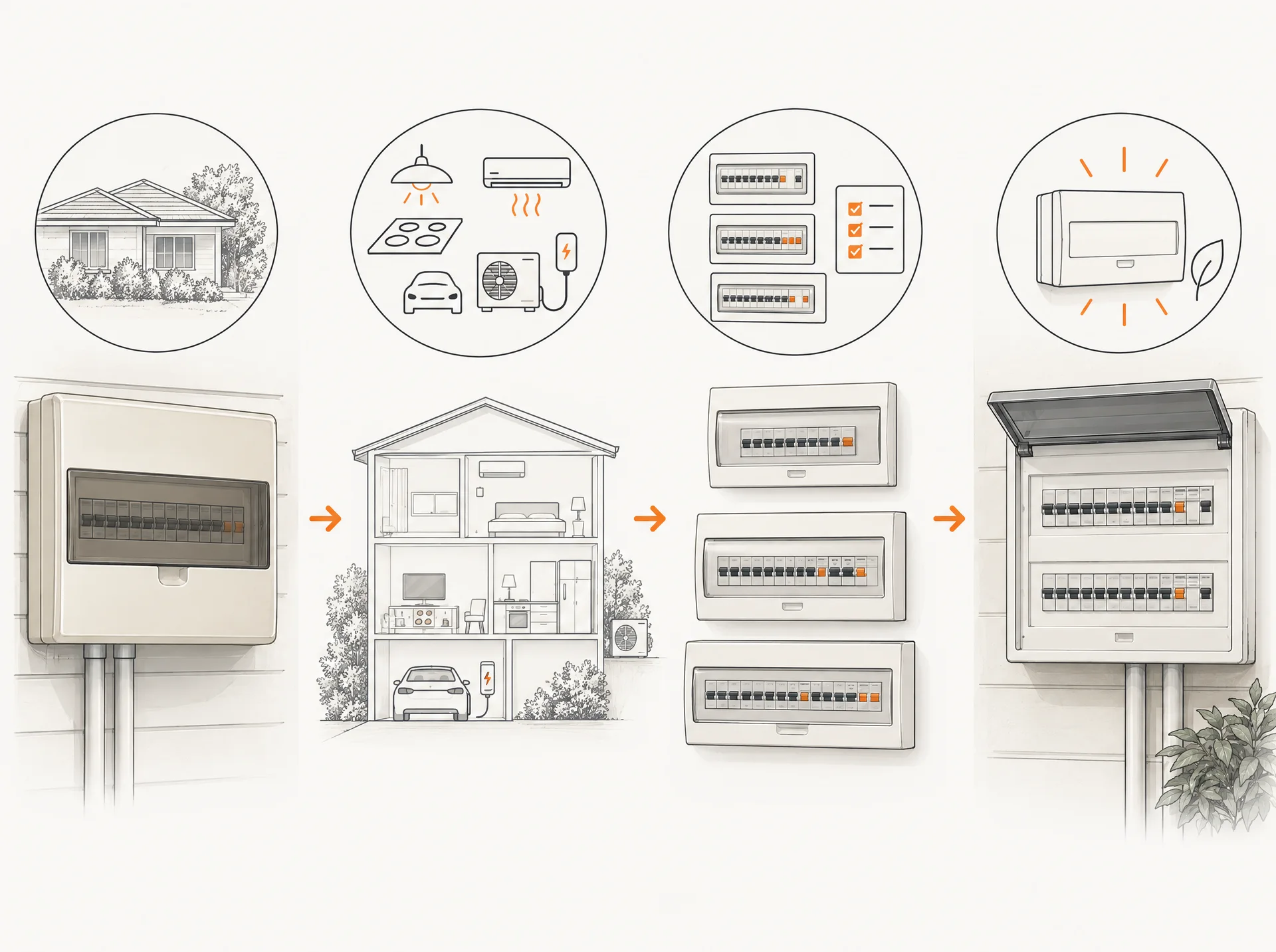
Explain what prompted the assessment
A renovation, recurring tripping, a new high-load appliance or an unfamiliar old board each raises different questions. Tell the electrician what has changed and what you want the property to support. Include past reports if you have them.
A switchboard is part of the electrical installation. Its enclosure, devices, circuit identification and connected wiring need to be considered together. Replacing the board does not automatically resolve every issue elsewhere in the property.
Understand the protection being discussed
RCDs detect certain leakage conditions and are different from devices intended to protect against overload or short circuit. The correct protection arrangement is a matter for the electrician to assess against the installation and current requirements.
Do not infer safety from the presence of a switch with a test button, or assume that every protective device serves the same purpose. The WA RCD guidance provides consumer information; it is not a substitute for an inspection.
Add the next stage of the property to the brief
List an EV charger, induction cooktop, new air-conditioning or additional commercial equipment if any are being considered. Supply capacity, existing circuits and space for new equipment can affect the proposal.
Ask the quote to distinguish the board work from new circuits, wiring repairs and changes to the incoming supply. This makes alternatives easier to compare and avoids treating every upgrade as the same package.
- Current concerns and previous fault history.
- Planned appliances and equipment.
- Known circuit information or earlier reports.
- Access arrangements and acceptable interruption times.
Prepare safely for the visit
A photograph of the closed board can help with initial planning. Keep covers in place and avoid touching damaged equipment. Arrange access and discuss how any power interruption affects refrigeration, business systems or other important equipment.
If you have received an electric shock or there is an immediate electrical danger, seek urgent assistance rather than waiting for a routine upgrade enquiry.
Keep observations separate from the diagnosis
An observation might be that a circuit trips when a particular appliance is used, or that an earlier report identified a defect. Record what happened, where and under what ordinary operating conditions. Do not open the board or recreate a fault to collect better evidence. Those observations help the electrician decide what to investigate; they do not establish which device or cable is at fault.
Ask the assessment to distinguish confirmed findings, suspected issues and parts that could not be checked. A quotation based on visible information may require further investigation. Knowing that limitation upfront is more useful than treating the first description as a complete diagnosis of all concealed wiring.
A planning example: an induction cooktop and future charging
Suppose a household is replacing its cooking appliance and considering an EV charger later. The useful brief includes the selected cooktop model, the charging requirement being considered and other major equipment already installed. The electrician can then assess the board, circuits and supply in that context. This example does not imply that either appliance automatically requires a board replacement.
Ask the proposal to separate work needed for the immediate appliance from provision for the future charger. Establish what would be installed now, what remains undecided and whether any supply-related work involves another party. That keeps a future option from being described as an operational installation.
Plan the interruption and the records
Discuss which areas may lose power, the expected work window and who needs notice. A business may need to coordinate computers, communications and staff access. A household may need to make arrangements around food storage or other equipment. The contractor should explain the planned interruption for the actual job; a general guide cannot promise a duration.
After the work, ask what was replaced, retained or left for a later stage. Keep the quote, findings and applicable completion documents with the property records. If further defects were found, they should be recorded as separate decisions rather than disappearing into a vague note that the board was upgraded.
- Reason for assessment and observed fault history.
- Immediate equipment changes and future options.
- Confirmed scope, exclusions and investigation limits.
- Interruption arrangements and the responsible contacts.
- Completion records and any remaining work.
Does an old board always mean a full rewire?
No. The assessment should establish which parts are suitable to retain and which need attention. Ask for findings, limitations and a defined work schedule. Further investigation may be needed where wiring is concealed or earlier alterations are undocumented.