Your project, in focus.Explore the details
What we can help with.
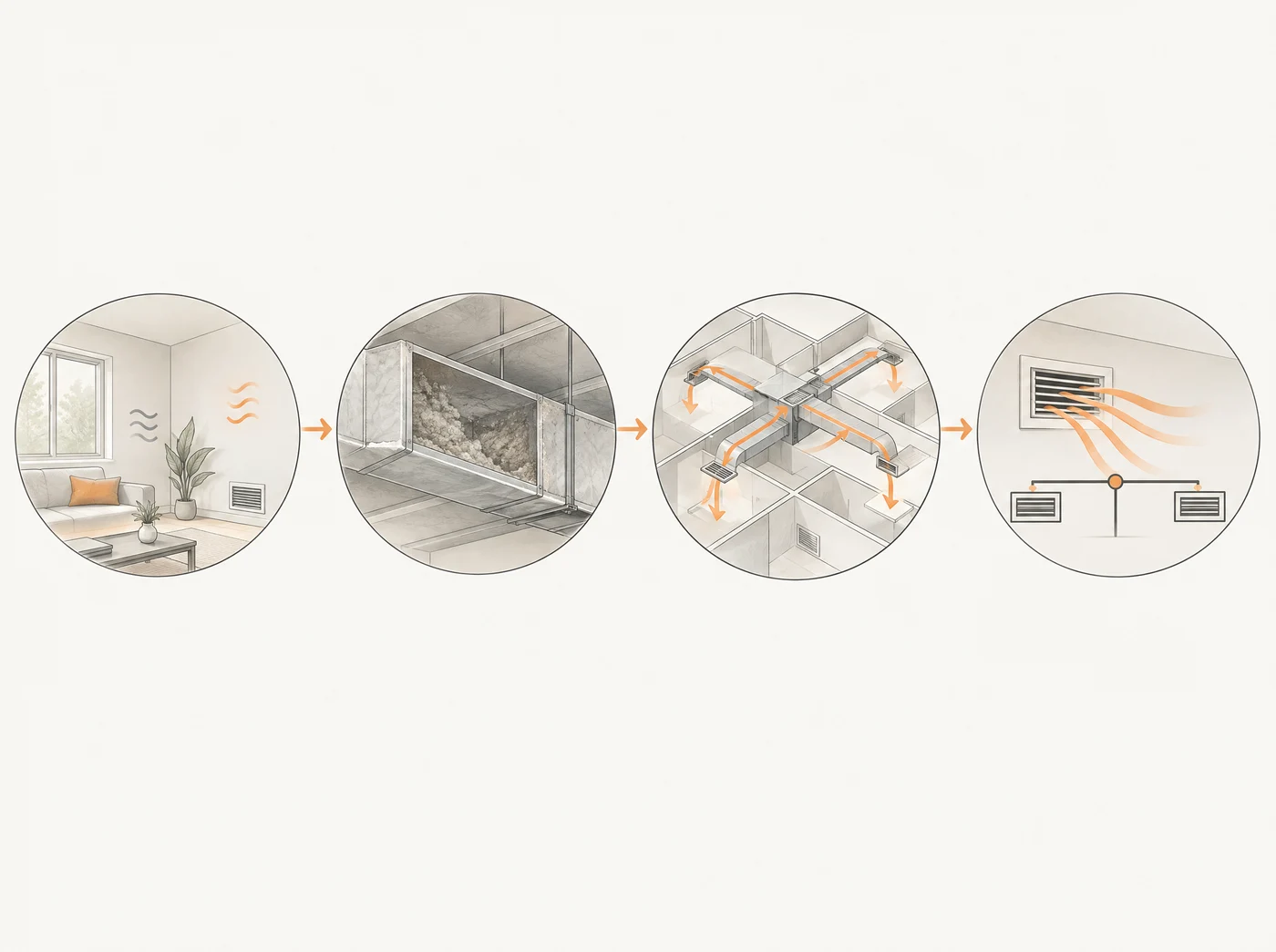
- Investigate damaged ducts, restrictions, outlets, return air and zone controls.
- Match the investigation to the rooms where comfort falls short.
Scope and site details
- Agree which ducts, outlets, returns or zone components can be accessed and assessed.
- Repairs may involve replacement sections, support, insulation or control work.
- Roof-space conditions and building alterations can affect access.
- Separate a distribution repair from work to the air-conditioning unit itself so the cause and proposed changes remain understandable.
What matters for your job.
- A room can receive insufficient air even when the unit is operating.
- Closing outlets or increasing fan speed may not address the cause.
- Changes need to account for the system as a whole.
Before we visit.
- Rooms affected and operating zones
- Time and weather when issues occur
- History of ceiling or roof work
- Existing plans or outlet layout
More to consider
- Identify rooms that are too warm, too cool or noisy and note which zones are running at the time.
- Provide plans and any history of roof work.
- Safe access to ceiling equipment must be assessed before investigation.
A clear handover.
- Check the affected rooms under the agreed operating configuration and record the work done to ducts, outlets or controls.
- Explain any remaining building or system limitation.
- Avoid presenting a brief airflow check as proof of identical temperatures in every weather condition.
Will replacing the air-conditioner fix poor airflow?
- Not necessarily.
- If the distribution system is restrictive or damaged, the same problem can remain with a new unit.
- Assess the duct and return-air arrangement first.
Can closing several outlets improve the room that feels warm?
- Closing outlets changes airflow and may not suit the system. Have the distribution and zoning assessed first.
- A warm room may reflect heat load, duct damage, controls or a restriction elsewhere.